Pause before stepping closer
Stop where your own footprints will not overwrite the evidence. Look for an established path or a firm edge from which you can observe. A promising patch of mud may also be a drinking place, a fragile bank or a route still in use. Do not block it while you work. If an animal is present, its need for space takes priority over a measurement.
Begin with the setting: sheltered woodland, exposed sand, drying mud or shallow snow. Note recent rain and whether the impression lies under a drip line or beneath vegetation. These details matter because the surface helps create the shape you see. Soft ground can spread a print; melting snow can enlarge it; hard soil may preserve only claws or a partial hoof.
Describe before naming
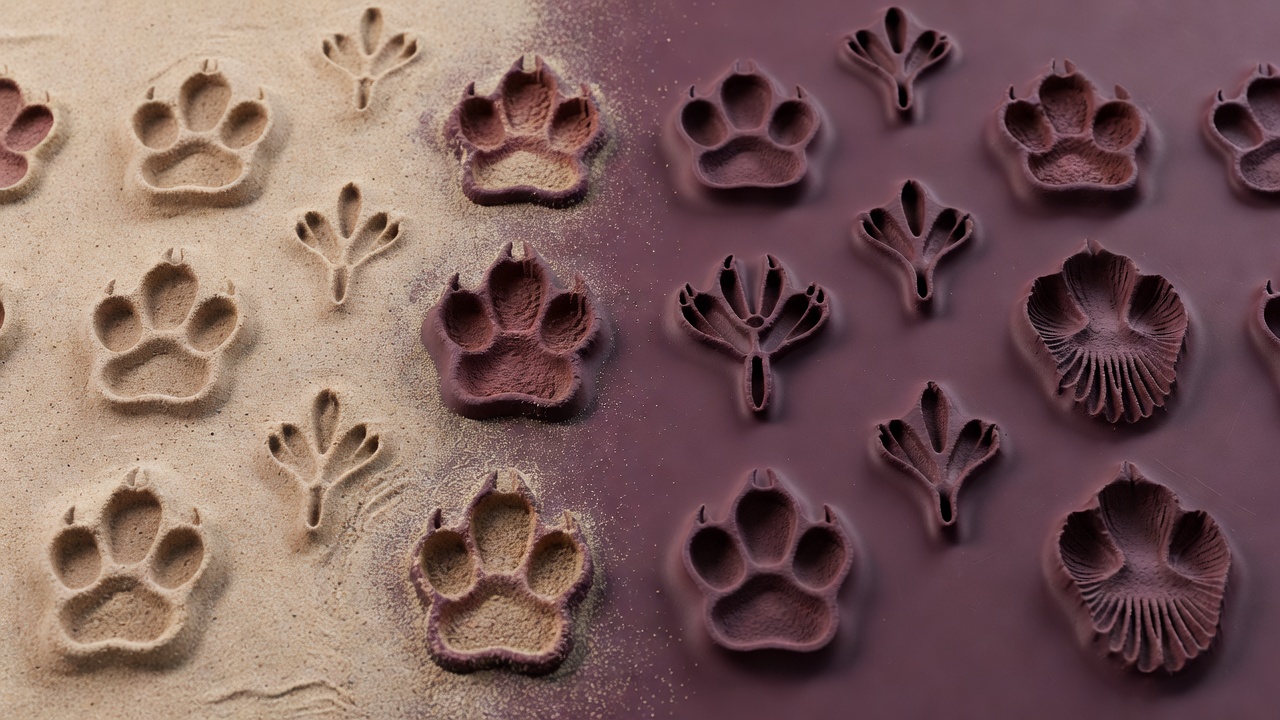
Write down the visible features in ordinary language. Count clearly preserved toes, describe the main pad or hoof divisions, and note whether claw marks are present. Record “not visible” rather than “absent” when an incomplete impression prevents a decision. A feature missing from the ground is not necessarily missing from the animal.
Measure length and width only when you can do so without damaging the site. Photograph the print as close to perpendicular as practical, with a scale beside it in the same plane. Keep the scale out of the impression. Take a wider contextual image as well, but remove sensitive landmarks before sharing. Perspective and an elevated ruler can make a photograph misleading.
A useful evidence row
Read a sequence, not a silhouette
A trackway can be more informative than the neatest individual print. Look for repeated foot placements, the spacing between steps and changes in direction. Forefeet and hindfeet may overlap, producing an impression that does not resemble a clean field-guide drawing. Several animals using the same route can create a false sequence.
Record your measurement convention rather than writing an unexplained number. For example, say whether you measured between successive impressions on the same side or between neighbouring prints. Avoid inferring an exact speed from spacing alone. Gait, slope, substrate and body size all influence a trackway, and a brief preserved section may not show the movement before or after it.
Canid and felid comparisons are useful starting exercises, but simple rules about claws or roundness are not decisive. Domestic dogs complicate many sites, and partial prints can conceal key features. Keep a broad group-level identification when the evidence does not support a species.
Let other signs remain independent
Scat, browsing, hair, feathers and disturbed ground can provide additional context. They do not automatically belong to the animal that made the nearest track. Record each sign separately, including its position relative to the trackway, before suggesting a connection. Distinguish a directly observed association from proximity alone.
Do not handle, smell closely or break apart scat. It can carry pathogens. Leave feathers, bones, nests and other remains in place; possession may be restricted even when an object looks abandoned. Do not place food near a track to attract its maker. If you encounter an injured animal or evidence of suspected wildlife crime, step back and contact the appropriate local authority rather than investigating.
Finish with an honest confidence label
Freshness is usually a range of possibilities, not a clock. A crisp edge may survive in sheltered ground, while a recent track can deteriorate quickly in rain. A print crossing a known recent footprint may establish a relative sequence, but only if you are confident about the overlap. Write what the evidence constrains and leave the rest open.
End your note with a working identification, its supporting features, plausible alternatives and what would help resolve the uncertainty. “Unidentified mammal track” is a valid record. Revisit only if access is lawful and another visit will not disturb wildlife. The purpose is to improve your observation, not to pursue an animal until uncertainty disappears.